


Summarize this blog post with:


In this article, you’ll learn which AI visibility optimization tools are worth your budget, which ones oversell and underdeliver, and how to evaluate them based on the features that actually move the needle for small and mid-market teams. You’ll also see how traditional SEO tools like Ahrefs and Semrush stack up against purpose-built platforms, and why the best tool for tracking AI visibility should also help you improve it.
We spent 90+ days testing every tool on this list across real brand projects. We tracked the same prompts, compared outputs, and documented what each platform can and cannot do. This is the honest breakdown.
Table of Contents
Why You Need an AI Visibility Tool (and Why Your SEO Stack Isn’t Enough)
More buyers are getting answers from ChatGPT, Perplexity, Gemini, and Claude before they ever visit Google. These AI engines don’t just list links. They describe your product, compare you to competitors, and shape purchase decisions in a single response.
Your existing SEO tools were not built for this. They track keywords, backlinks, and SERP positions. They do not tell you what ChatGPT says when someone asks “best CRM for startups” or whether Perplexity recommends your competitor instead of you.
That gap is where AI visibility optimization tools come in. They monitor how AI engines talk about your brand, track your position in AI-generated answers, and give you the data to improve what’s being said.
But not all tools are equal. Some only monitor. Some only track one or two engines. Some charge enterprise prices for features you can get at a fraction of the cost. Here’s how to sort them out.
What to Look for in an AI Visibility Tool
Before picking a tool, you need to know which capabilities actually matter. Based on our testing, here are the six that separate useful platforms from expensive dashboards.
Prompt-level tracking. You need to monitor specific prompts daily, not just see a one-time snapshot. AI responses shift constantly, and weekly or monthly checks miss the changes that matter.
Multi-engine coverage. ChatGPT, Perplexity, Gemini, Copilot, and Google AI Overviews each have different source preferences. A tool that only covers one or two engines gives you a partial picture.
Citation analytics. Knowing you’re mentioned is not enough. You need to see which URLs AI engines cite when they mention your brand and your competitors. That tells you where to focus your content efforts.
AI traffic attribution. The best tools connect AI mentions to actual traffic. If you can’t tie visibility to GA4 sessions, you’re guessing about ROI.
Content creation and optimization. Monitoring without action is just a dashboard. Look for tools that help you write content designed to earn AI citations and optimize existing pages that are being ignored.
Competitive benchmarking. You need to see who’s winning the prompts you care about, what sources they’re cited from, and where your gaps are.
The table below shows how each tool stacks up against these criteria.
|
Platform |
Daily Tracking |
Engines Covered |
Citation Analytics |
AI Traffic (GA4) |
Content Writer/Optimizer |
Agent Builder |
Starting Price |
|---|---|---|---|---|---|---|---|
|
Yes |
6+ |
Yes |
Yes |
Yes |
Yes (180+ nodes) |
$99/mo |
|
|
Profound |
Yes |
5 |
Yes |
Yes (CDN-based) |
Limited |
Limited |
$99/mo |
|
AthenaHQ |
Yes |
8 |
Yes |
Yes (GA4/Shopify) |
Content agents |
No |
$295/mo |
|
Peec AI |
Yes |
6+ |
Basic |
No |
No |
No |
~$95/mo |
|
Ahrefs (Brand Radar) |
No |
5 |
Limited |
No |
No |
No |
$199/mo |
|
Semrush (Otterly) |
Weekly |
4 |
Basic |
No |
No |
No |
$99/mo add-on |
|
Surfer (AI Tracker) |
Partial |
3 |
Limited |
No |
Content only |
No |
$95/mo |
|
Wix |
Auto-generated |
4 |
Basic |
Yes (GA4) |
No |
No |
Included |
The 8 Best AI Visibility Optimization Tools, Reviewed
1. Analyze AI: The Agentic Platform for SEO, AEO, Content, and GTM Ops
Most AI visibility tools do one thing. They monitor. Analyze AI monitors, analyzes, creates content, optimizes existing pages, benchmarks competitors, attributes traffic, and automates entire workflows through a programmable Agent Builder with 180+ nodes.
That last part is what makes it different from everything else on this list.
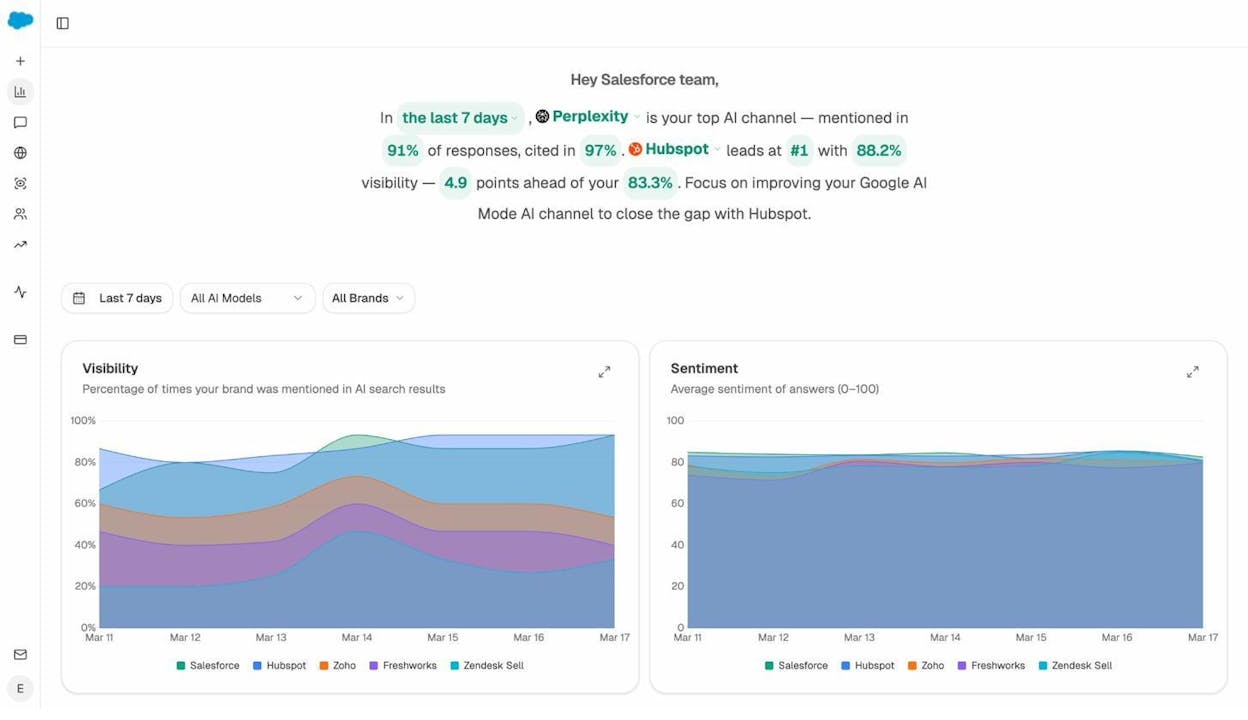
Tracking and monitoring. You get daily prompt tracking across ChatGPT, Perplexity, Gemini, Copilot, Google AI Mode, and more. Each prompt shows your rank, visibility score, sentiment, and which sources the AI cited. You also get on-demand prompt searches through AI Search Explorer for quick competitive checks.
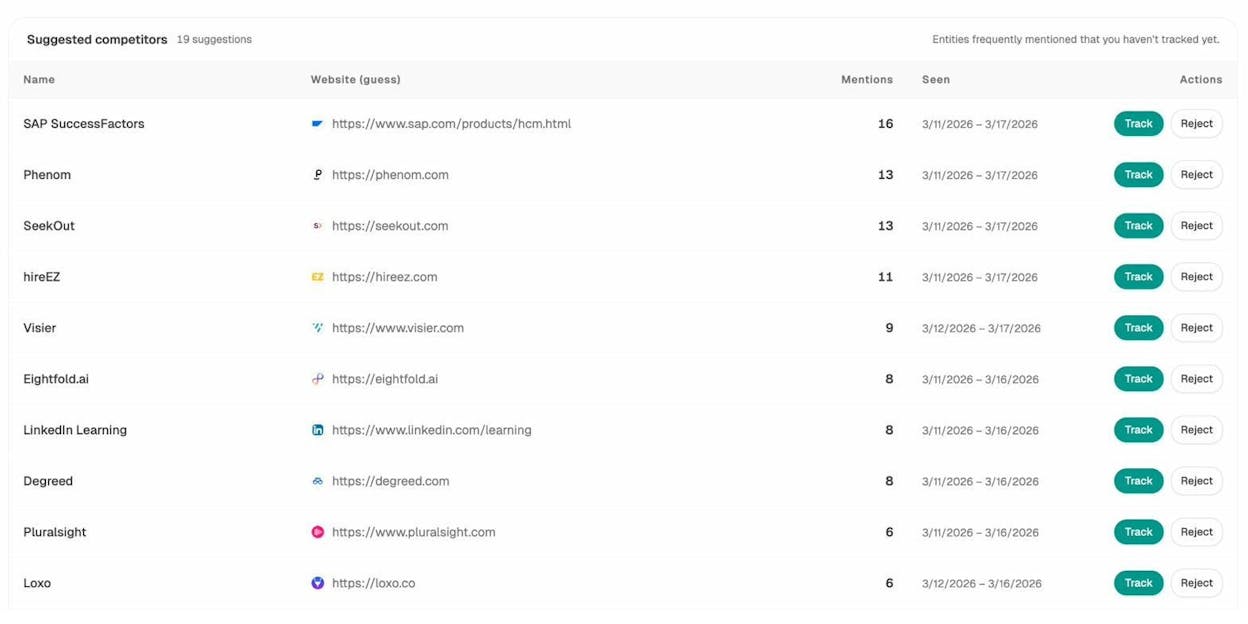
Competitive intelligence. The Competitor Intelligence dashboard shows who’s winning the prompts you track, their share of voice, and the exact sources earning them citations. It also suggests competitors you should be tracking based on how often they appear alongside your brand in AI responses.
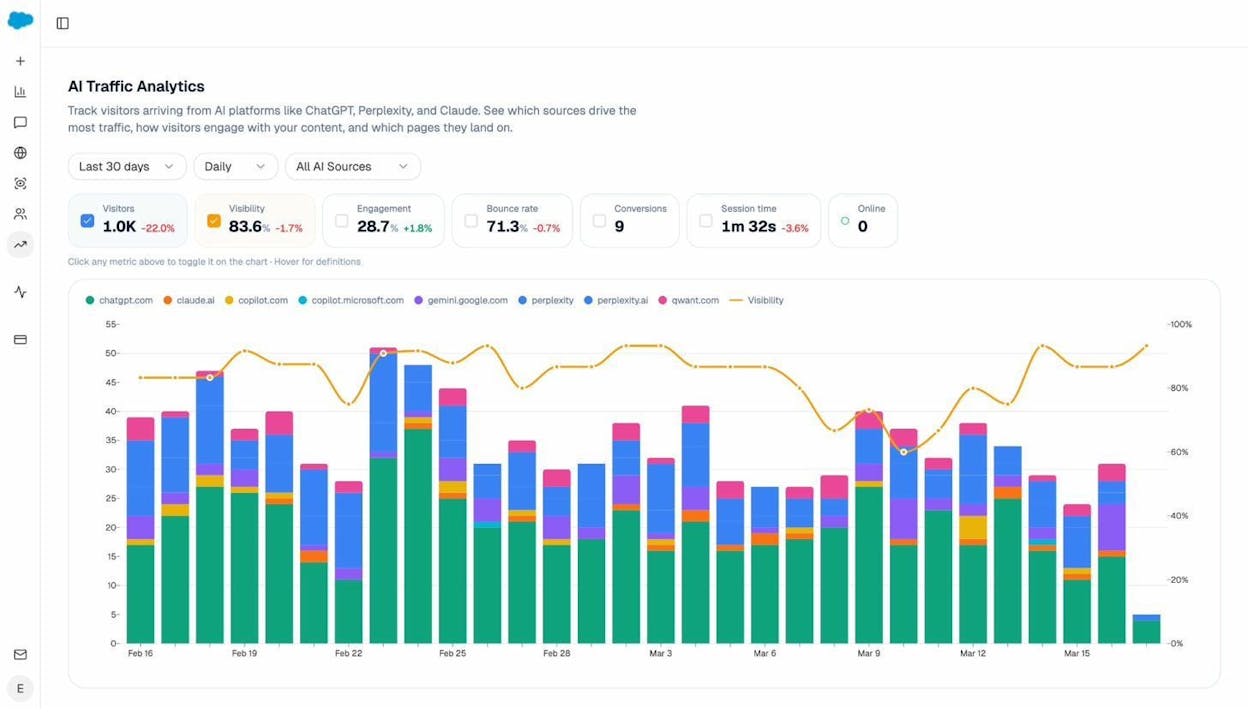
AI traffic attribution. Connect GA4, and AI Traffic Analytics shows you exactly which AI engines send visitors to your site, which pages they land on, and how that traffic trends month over month. This is the feature that turns visibility data into something your CMO will care about.
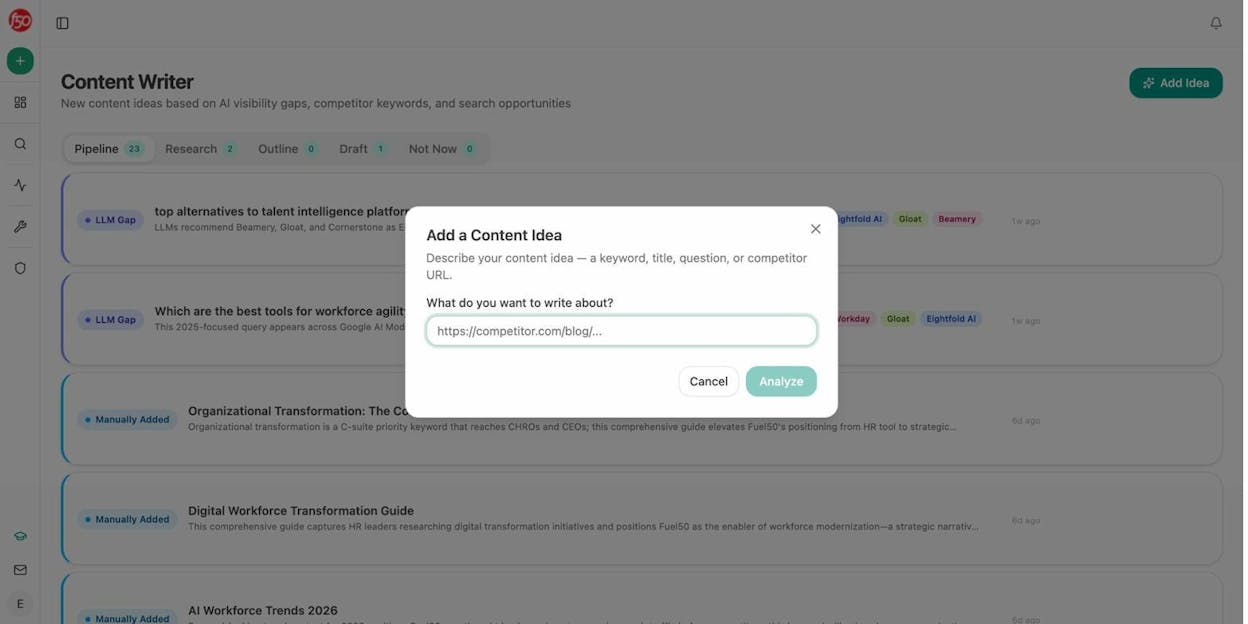
Content creation that earns citations. The AI Content Writer does not just generate text. It runs a multi-step pipeline that covers research, outline with editorial comments, and a full draft that targets both traditional search keywords and AI visibility gaps. The AI Content Optimizer audits existing URLs and rewrites them with specific citation-earning improvements.
The Agent Builder is the real differentiator. This is not a simple automation layer. It is a programmable substrate with 180+ production-ready nodes, 34 pre-built data recipes, and direct integrations with GA4, Google Search Console, DataForSEO, Semrush, HubSpot, Notion, WordPress, Slack, and every major LLM. You can build agents that run on a schedule, fire on a webhook, or execute on demand.
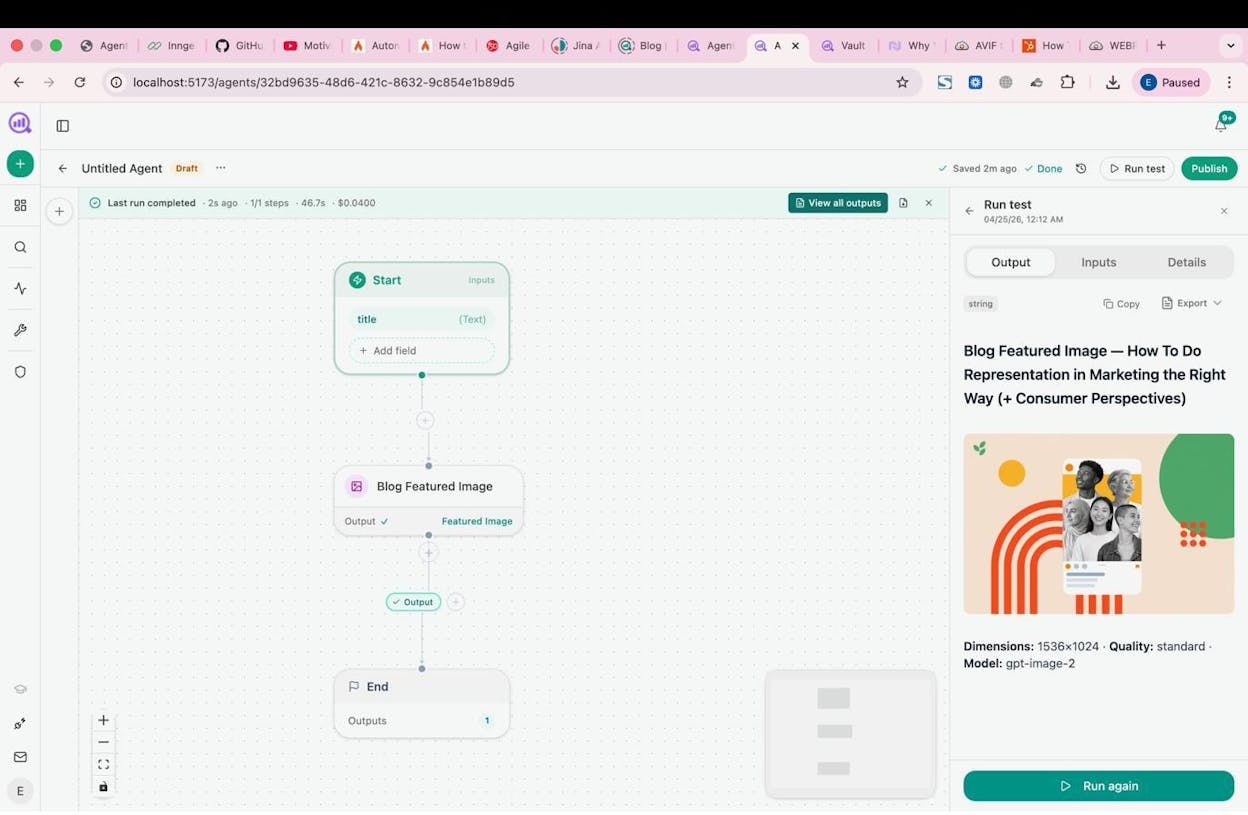
Here are real examples of what teams build with it:
-
A Monday board prep agent that pulls your AI visibility data, GA4 traffic, competitor shifts, and new HubSpot deals into an executive summary delivered to Slack every Monday at 7am. That replaces a 4-hour analyst workflow.
-
A brief-to-publish pipeline triggered when a content brief moves to “approved” in Notion. It generates research, builds an outline, writes a full draft with brand voice injected, scores it for AI citation readiness, and publishes to WordPress if the score passes. If it fails, it sends the gaps to the writer via Slack.
-
A crisis early-warning agent that scans brand mentions every 15 minutes, filters for negative sentiment above a threshold, and alerts your PR team with the source URLs and a drafted response before your CEO hears about it.
With 180+ nodes across 16 categories, the practical surface is millions of useful configurations. A CMO ships board-grade intelligence on cadence without an analyst. An agency turns reporting day into a background process. A content team runs a publish pipeline that gates on quality automatically. These are not templates. You compose from primitives.
Pricing: $99/month (Growth) or $250/month (Pro). No credit-based surprises. Unlimited seats on all plans.
Best for: Teams that want to monitor, create, optimize, and automate AI visibility from a single platform without paying enterprise prices.
2. Profound
Profound is the most funded platform in this category, with $155M raised and a $1B valuation. It tracks brand visibility across ChatGPT, Perplexity, Gemini, Copilot, and Google AI Overviews. Its standout feature is Prompt Volumes, panel data from opted-in consumers showing what real users ask AI engines, with regional and demographic breakdowns. No one else ships this dataset.
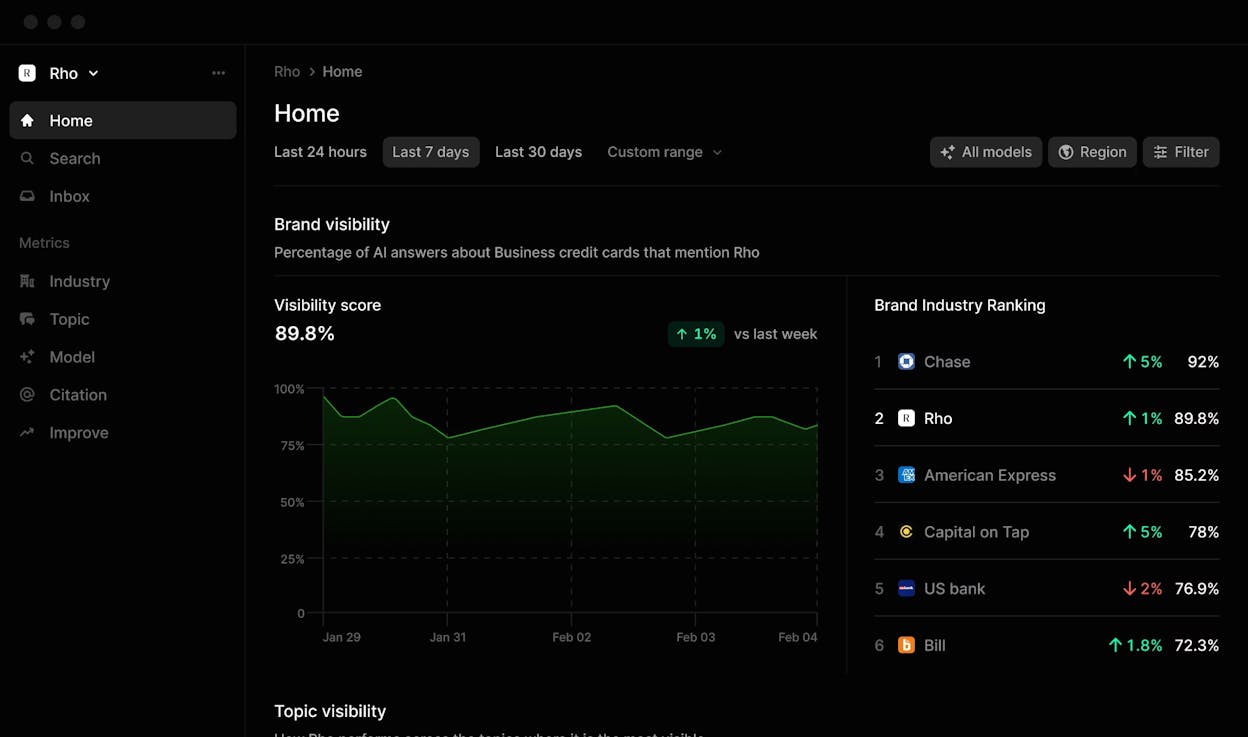
The platform also offers Conversation Explorer for finding buyer queries, Agent Analytics for tracking AI bot crawling activity on your site, and a content workflow called Profound Agents for generating and publishing AEO content.
The tradeoffs are significant. Profound does not support multi-account management, so agencies managing five clients need five separate accounts. The Agents feature is scoped to AEO content workflows only, not general marketing ops. And pricing starts at $99/month for a ChatGPT-only plan with 50 prompts. Multi-platform coverage starts at $399/month, and the features most people associate with Profound (Prompt Volumes, full API access, unlimited seats) are enterprise-only at custom pricing.
Best for: Enterprise teams with dedicated analysts who need panel-level prompt volume data and can justify $399+/month.
3. AthenaHQ
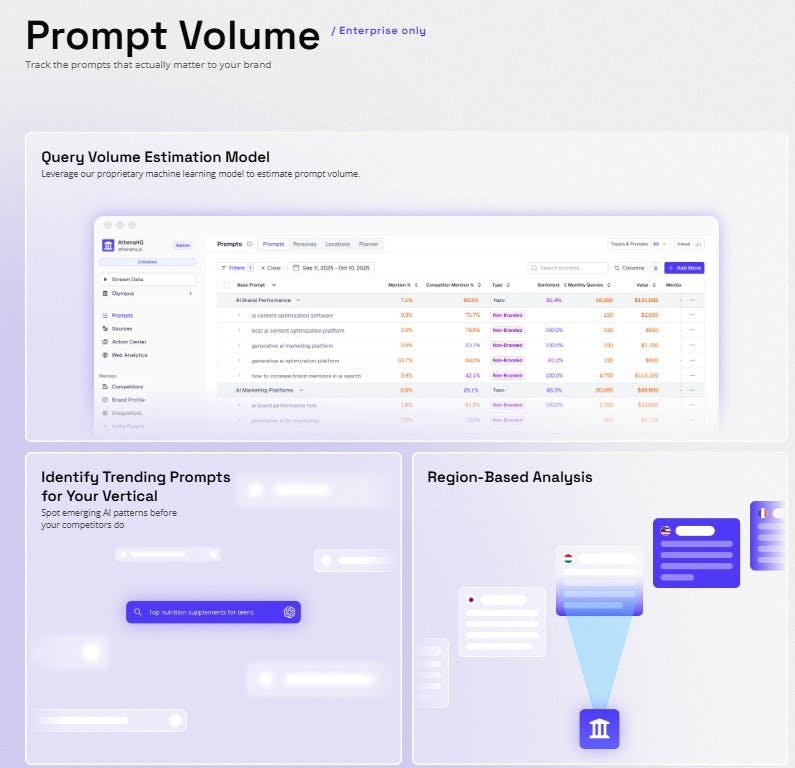
AthenaHQ covers 8 AI engines on every plan and offers a feature called Action Center that turns visibility gaps into structured, assignable optimization tasks. Founded by former Google Search and DeepMind engineers, it has strong technical foundations.
The challenge is pricing and predictability. AthenaHQ uses a credit-based model starting at $295/month for 3,600 credits. Every AI response you track consumes credits. Heavy monitoring across 8 engines burns through credits fast, and overage costs $100 per 1,250 additional credits. The most advanced features, including the ACE Citation Engine, persona targeting, and API access, are locked behind an enterprise tier at $2,000+/month.
The credit model makes monthly spend hard to predict. If you’re tracking 50 prompts across 8 engines daily, you can exceed your credit limit before mid-month. Teams that prefer fixed subscription pricing will find this frustrating.
Best for: Single-market teams comfortable with credit-based pricing who need structured optimization workflows and broad engine coverage.
4. Peec AI
Peec AI is the most accessible platform on this list. It offers clean, straightforward GEO tracking with daily prompt monitoring, sentiment scoring, ranking analysis, and share-of-voice charts across ChatGPT, Claude, Perplexity, Grok, and DeepSeek. The interface is intuitive and the learning curve is minimal.
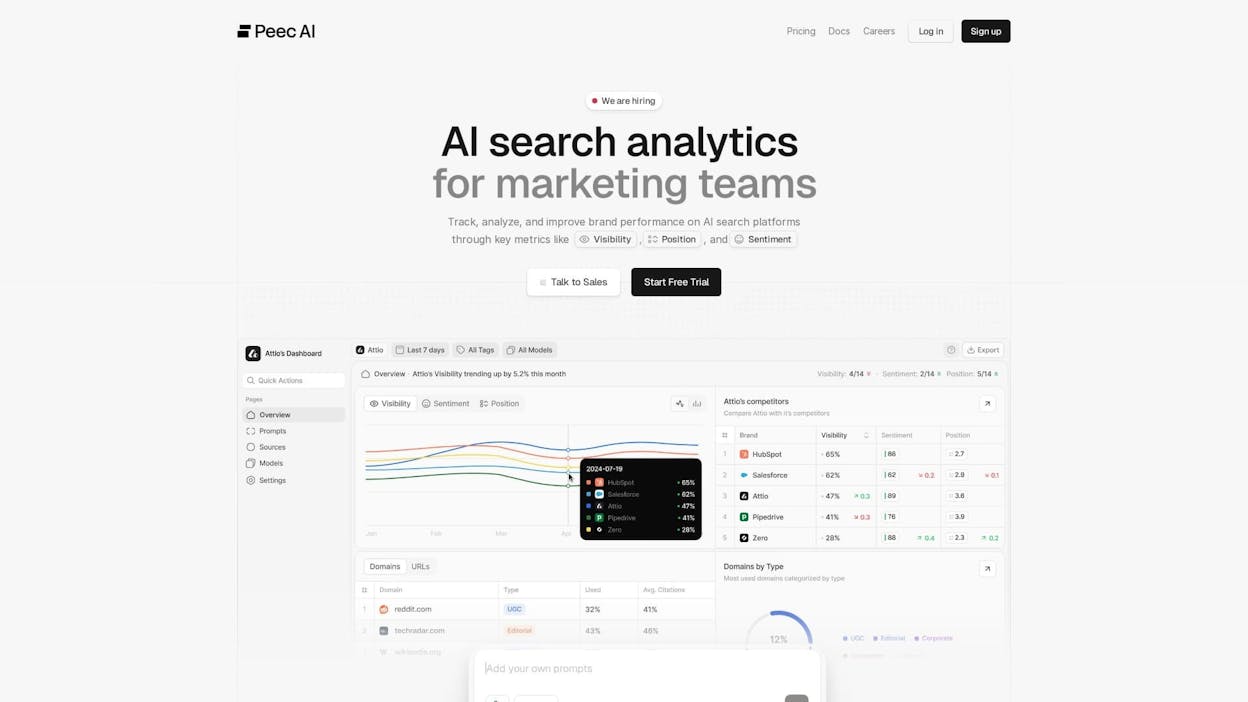
Peec is good for teams that want foundational visibility data without complexity. But it leans heavily toward passive monitoring. There’s no AI traffic attribution, no content creation or optimization workflows, and no way to take direct action from the data inside the platform. You’ll need to export insights and act on them in other tools.
Pricing: ~$95 to $199/month.
Best for: Small agencies and marketing teams who want a quick, affordable view of AI visibility without needing content or automation features.
5. Ahrefs (Brand Radar AI)
Ahrefs extended its brand monitoring suite with Brand Radar AI, which tracks how your brand appears in AI-generated answers across ChatGPT, Perplexity, Gemini, Copilot, and Google AI Overviews. It merges traditional web-based brand monitoring (unlinked mentions, linked mentions, ownership of AI Overviews) with emerging AI visibility signals.
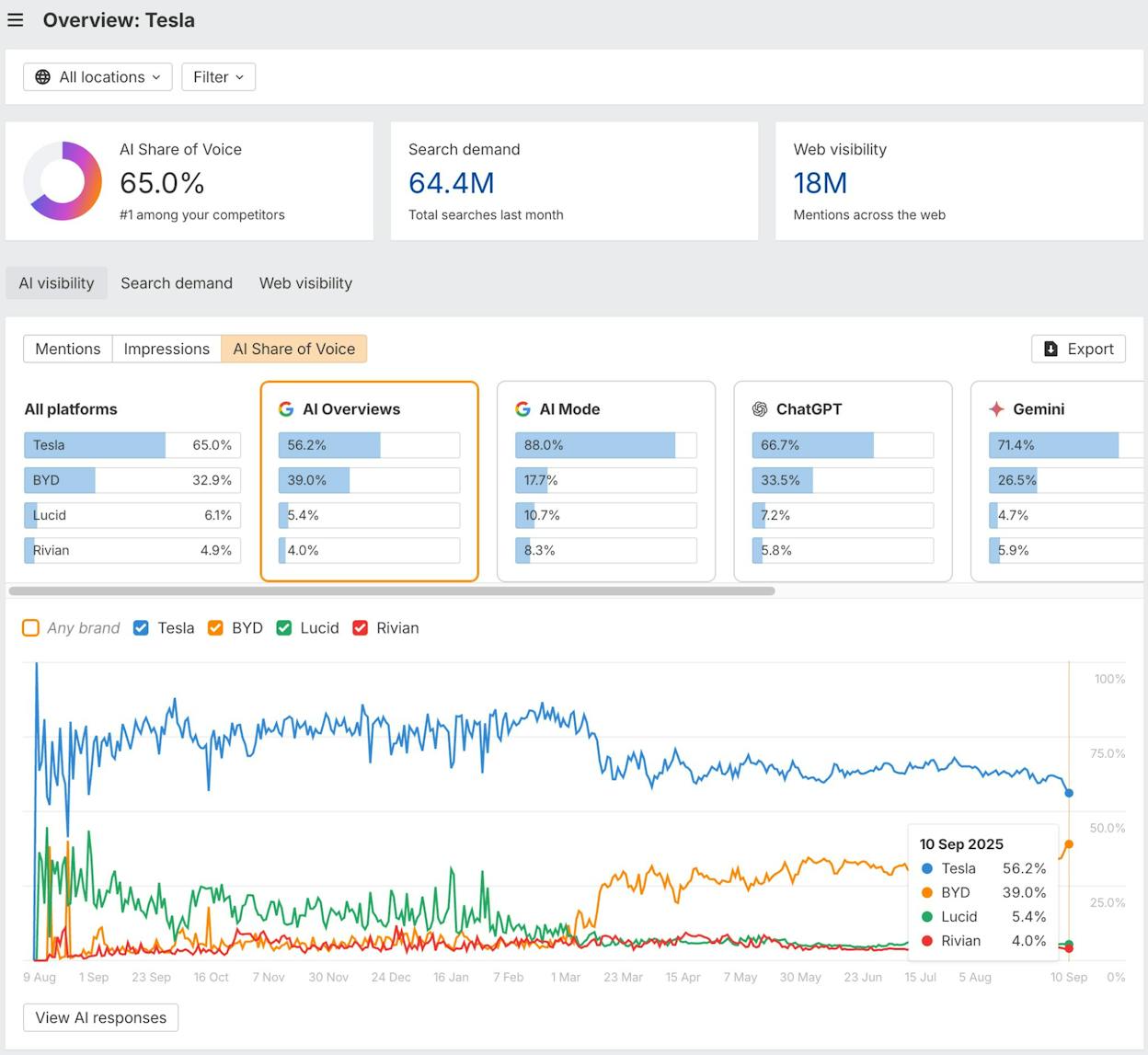
Brand Radar is designed to live inside the existing Ahrefs ecosystem. It’s a signal layer, not a full GEO workflow. There’s no prompt-level search, no daily prompt tracking, no AI traffic attribution, and no content optimization for AI visibility. If you already pay for Ahrefs and want a basic sense of how AI engines reference your brand, Brand Radar adds value. If you need to actively improve your AI visibility, you’ll outgrow it quickly.
Pricing: Starts at $199/month (requires an Ahrefs subscription).
Best for: Teams already using Ahrefs who want brand monitoring extended to AI contexts.
6. Semrush (via Otterly)
Semrush offers AI visibility through Otterly, a dedicated add-on that tracks how your brand appears in AI-generated content. It monitors visibility and sentiment across ChatGPT, Perplexity, SearchGPT, and Gemini, with weekly updated reports and competitive benchmarking.
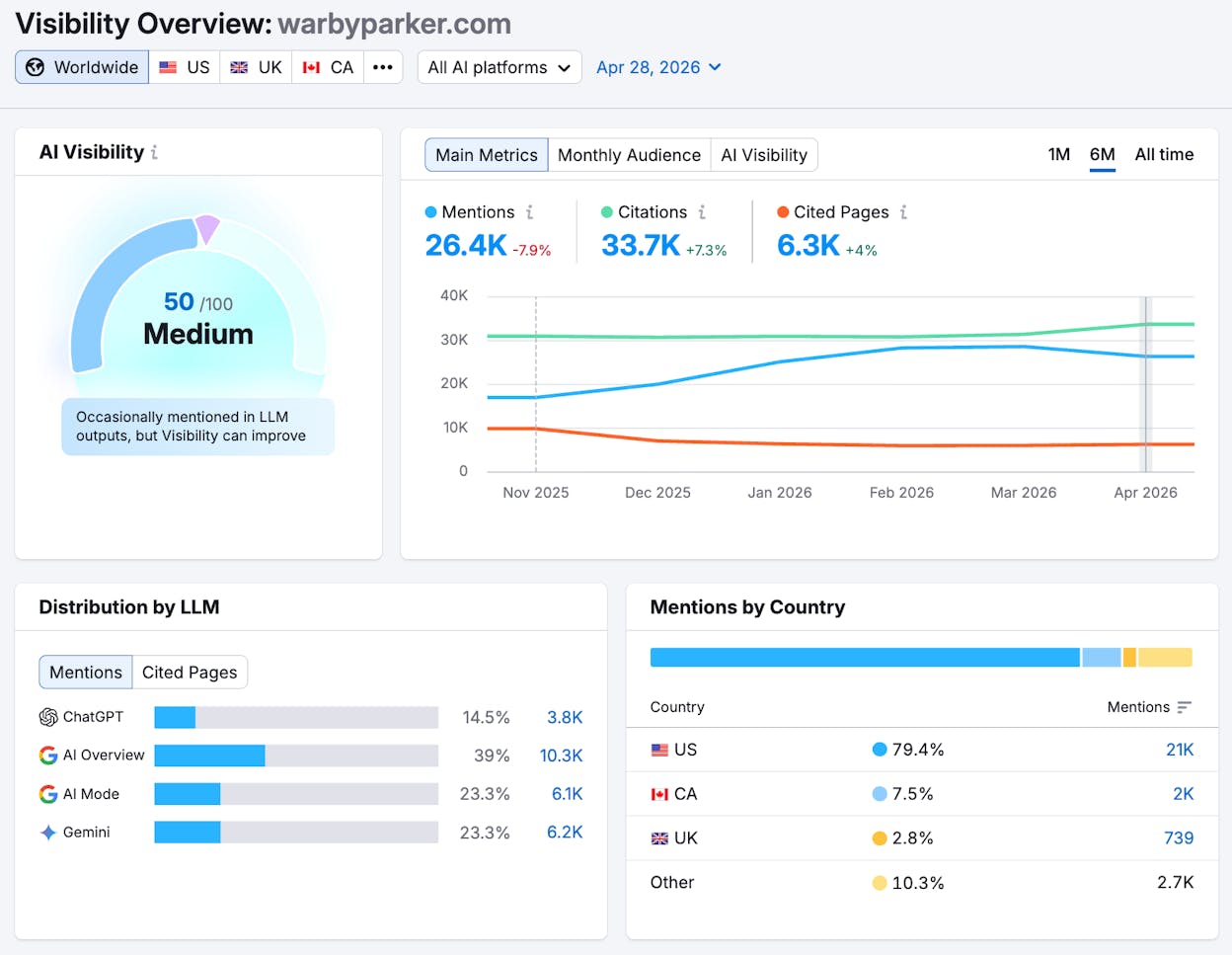
The weekly update cadence is the biggest limitation. AI responses change daily, and weekly snapshots miss shifts that matter. Otterly also lacks prompt-level detail pages, on-demand prompt search, and AI traffic attribution. It works as a bridge between keyword visibility and AI prompt visibility for teams already invested in Semrush, but it is not a standalone solution.
Pricing: $99/month per domain (on top of your Semrush subscription).
Best for: Semrush users who want to add basic AI visibility reporting to their existing workflow.
7. Surfer (AI Tracker)
Surfer’s AI Tracker lets you monitor how specific prompts are answered by ChatGPT, Claude, and Perplexity. You choose from 25, 100, or 300 prompts depending on your plan, and Surfer refreshes a portion of them daily.
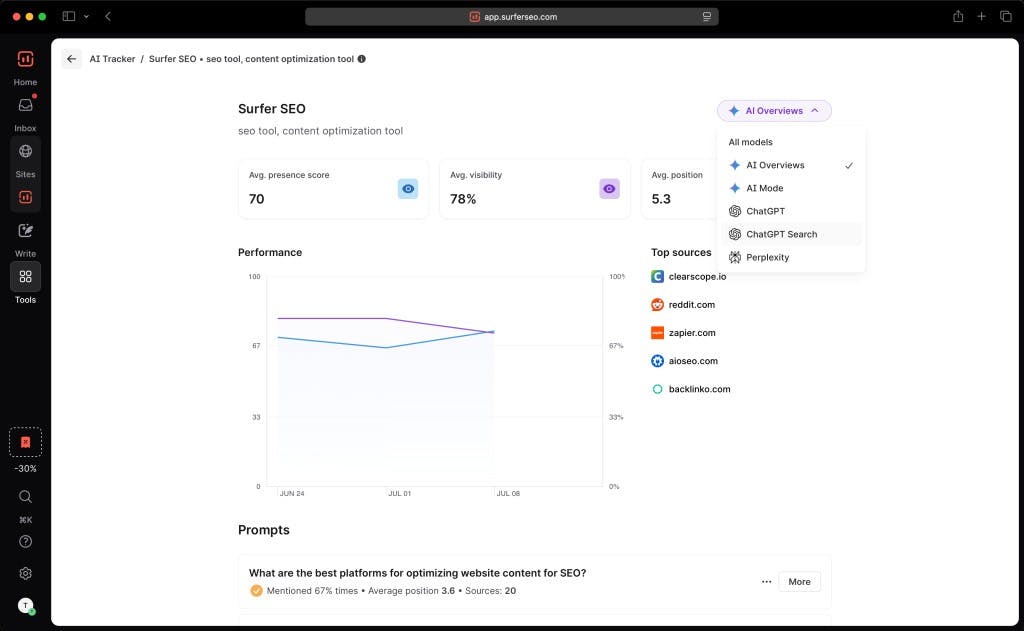
The tracking sits alongside Surfer’s content optimization tools, which makes it appealing for writers and SEO teams. But the AI tracking itself is lightweight. There’s no prompt suggestion engine, limited citation analysis, no competitive benchmarking dashboard, and no AI traffic integration.
Pricing: Starts at $95/month for 25 prompts, scaling to $495/month for 300 prompts, on top of a base Surfer subscription.
Best for: Content teams already using Surfer who want to add basic AI prompt monitoring.
8. Wix (AI Visibility Overview)
Wix offers a native AI Visibility Overview inside its platform. It auto-generates industry-relevant prompts, tests your visibility across ChatGPT, Gemini, Claude, and Perplexity, and returns a proprietary AI Visibility Score. It also includes competitor benchmarking, sentiment analysis, GA4-based traffic tracking, and generates an LLMs.txt file for controlling bot access.
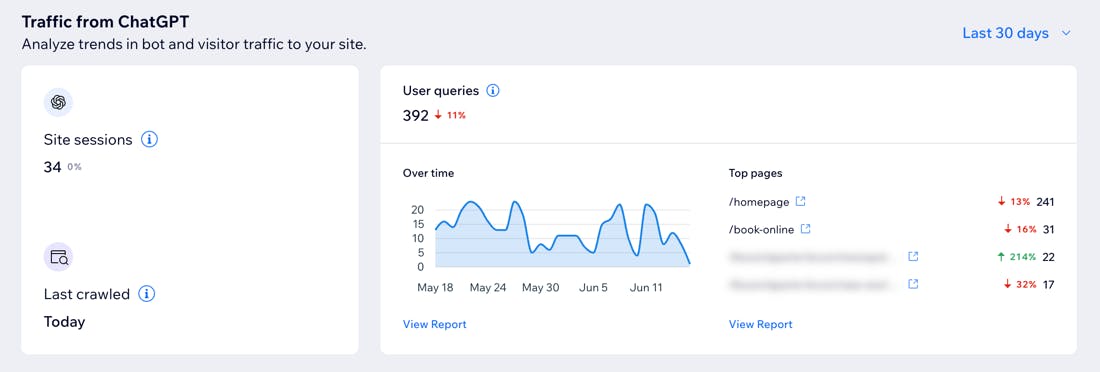
For Wix users, this is surprisingly capable as a built-in feature. But it’s limited to Wix-hosted sites, the prompts are auto-generated rather than custom, and there’s no content optimization workflow or competitive depth beyond basic benchmarking.
Best for: Small businesses on Wix who want AI visibility insights without adopting a separate tool.
How to Use AI Visibility Data Alongside Your SEO Workflow
Here’s something most AI visibility articles won’t tell you: SEO is not dead. AI search is an additional organic channel, not a replacement for traditional search. The brands winning in AI answers are the same ones investing in quality content, technical SEO, and topical authority. The difference is that now your content has to work for AI models too.
That means the smartest approach is to layer AI visibility on top of your existing SEO workflow, not replace it.
Use AI traffic data to validate what’s working. Once you connect GA4 to a tool like Analyze AI, look at which pages receive AI referral traffic. These pages are already doing something right for AI engines. Study the patterns. What topics they cover, how they’re structured, what sources they cite. Then double down on what works.
Discover prompts you should target with content. Prompt discovery surfaces the queries where your competitors appear and you don’t. These are content gaps you can fill. Many of these prompts map directly to traditional search keywords too, which means one piece of content can win in both channels.
Monitor your brand narrative across engines. AI engines don’t just rank you. They describe you. AI Sentiment Monitoring and the Perception Map show you exactly how each engine frames your brand. If ChatGPT describes your product as “affordable but limited” while Perplexity calls it “full-featured,” you have a messaging problem to fix with targeted content.
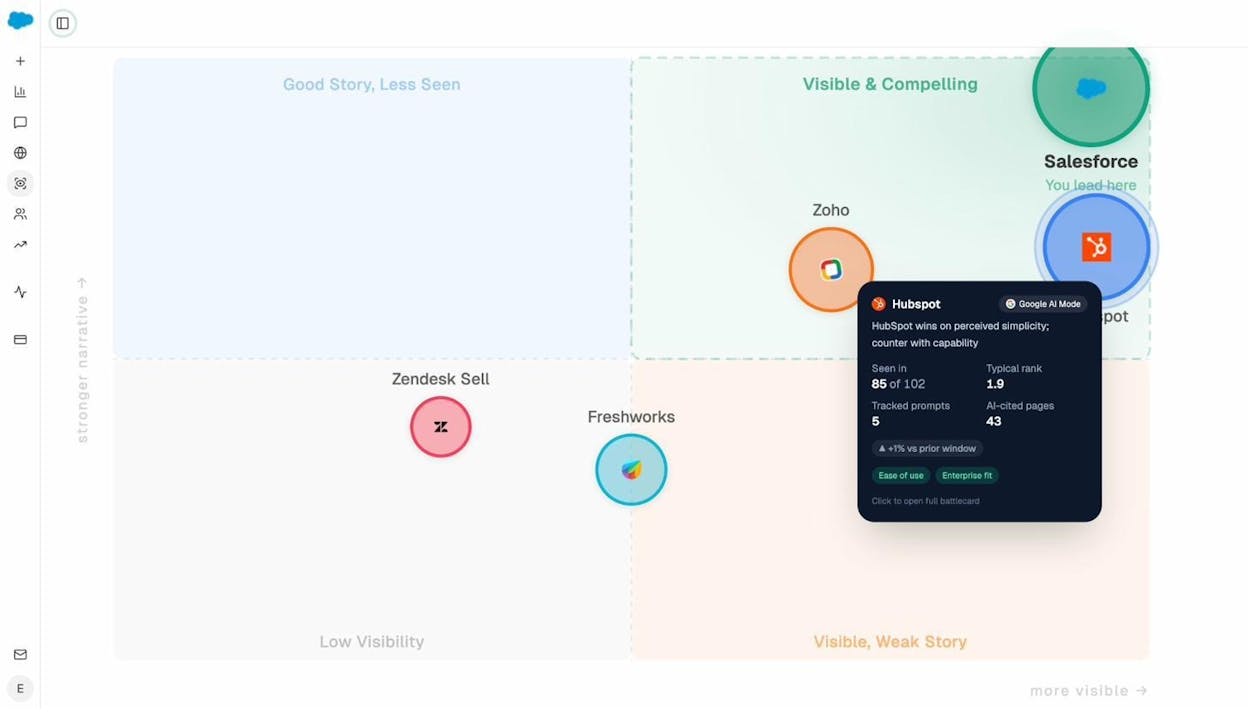
Automate the repetitive work. If you’re manually checking AI answers, pulling competitor data, writing reports, or scanning for negative mentions, you’re spending hours on work that should run in the background. An Agent Builder with scheduled triggers, webhook integrations, and direct CRM connections turns these tasks into set-and-forget processes. You focus on strategy. The agents handle operations.
Which AI Visibility Tool Is Right for You?
If you’re just exploring the space and want a low-commitment starting point, Peec AI ($95/month) or Wix (included) give you basic visibility data without complexity.
If you’re already invested in a traditional SEO suite and want to add AI visibility as a signal, Ahrefs Brand Radar, Semrush Otterly, or Surfer AI Tracker extend what you already use, but none of them offer the depth to actively compete in AI search.
If you need enterprise-grade panel data and your budget supports it, Profound ($399+/month) delivers unique prompt volume insights that no one else has.
If you want the most complete platform at a price point that makes sense for small and mid-market teams, Analyze AI ($99/month) gives you daily tracking, multi-engine coverage, citation analytics, GA4 traffic attribution, a full content creation and optimization stack, and a 180+ node Agent Builder that extends into SEO research, CRM, CMS, email, and virtually anything else your marketing operations need.
The question is not whether you need an AI visibility tool. You do. The question is whether you want one that monitors, or one that monitors, creates, optimizes, and automates. Start with Analyze AI and see the difference.

Ernest

Ibrahim


